Building Credibility for Product Adoption at an Early-Stage Beauty Marketplace
How do we earn client trust when a marketplace platform is new and the providers are strangers?
COMPLETED:
SKILLS:
Product Strategy
Experience Design
Quick Iteration
ROLE:
Solo Product Designer for Vishmo
IMPACT
200% increase in booking clicks
4.5x increase in average time spent on the page
THE "MESS"
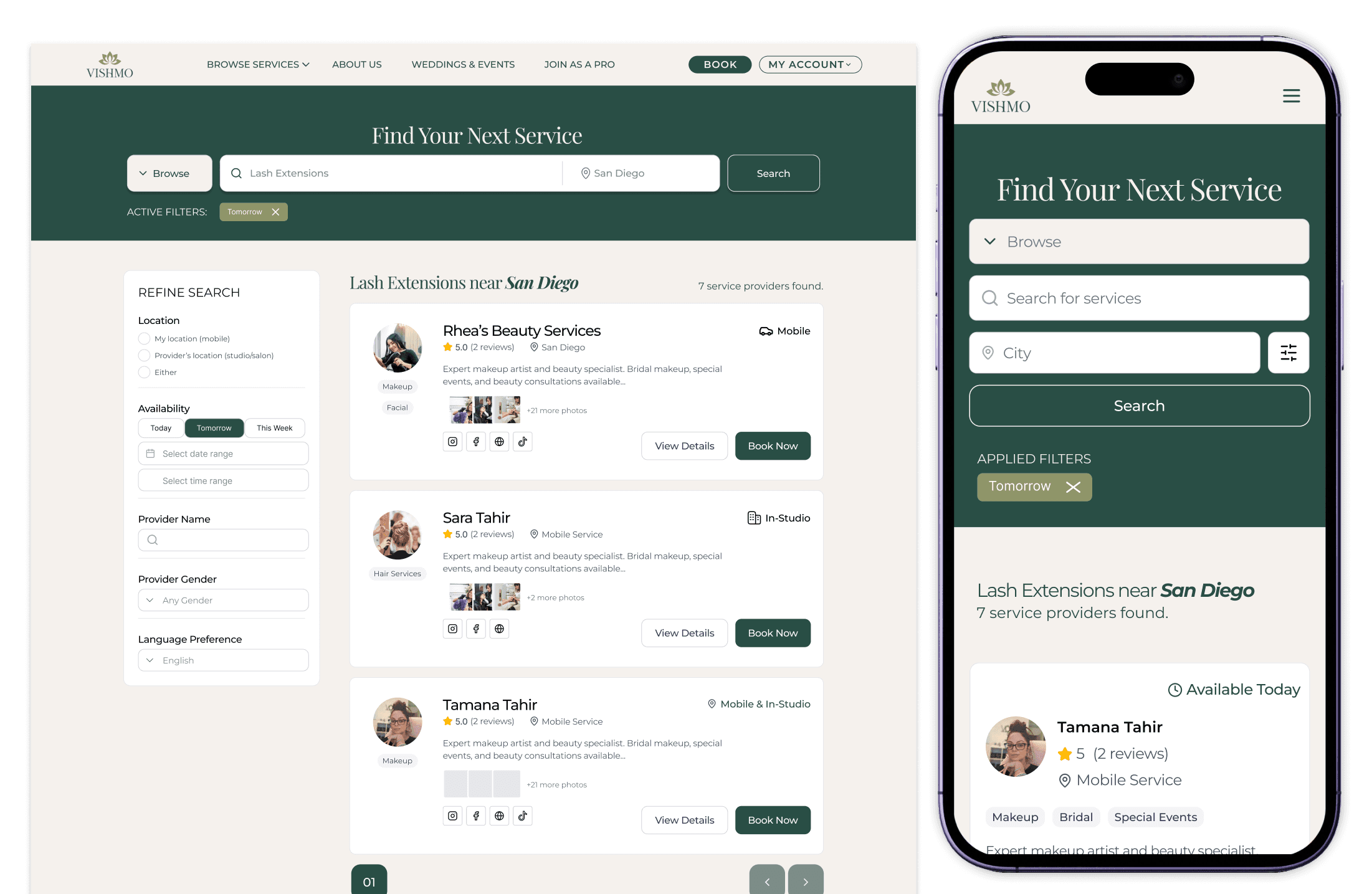
How do we get clients to trust our early-stage platform & our listed providers enough to commit to booking?
Without review history or brand recognition, the search page actively exposed how unestablished the platform was, right at the moment clients were deciding whether to trust it enough to book beauty and wellness services.
Because we had <20 active providers, conversion was not a meaningful KPI just yet. This work instead prioritized increasing brand awareness and site engagement.
To Do:
Convey provider credibility to entice clients to book
Communicate platform value to increase trust in the brand
Design for a low provider count without limiting future scale
THE SOLUTION
Make users evaluate beauty and wellness providers over services
Search was redesigned for clients to evaluate providers holistically to mimic the way relationships are established in the beauty industry, even when that meant increasing time spent reviewing providers before committing to booking.
Shift Core Trust-Building from the Platform to Established Professionals
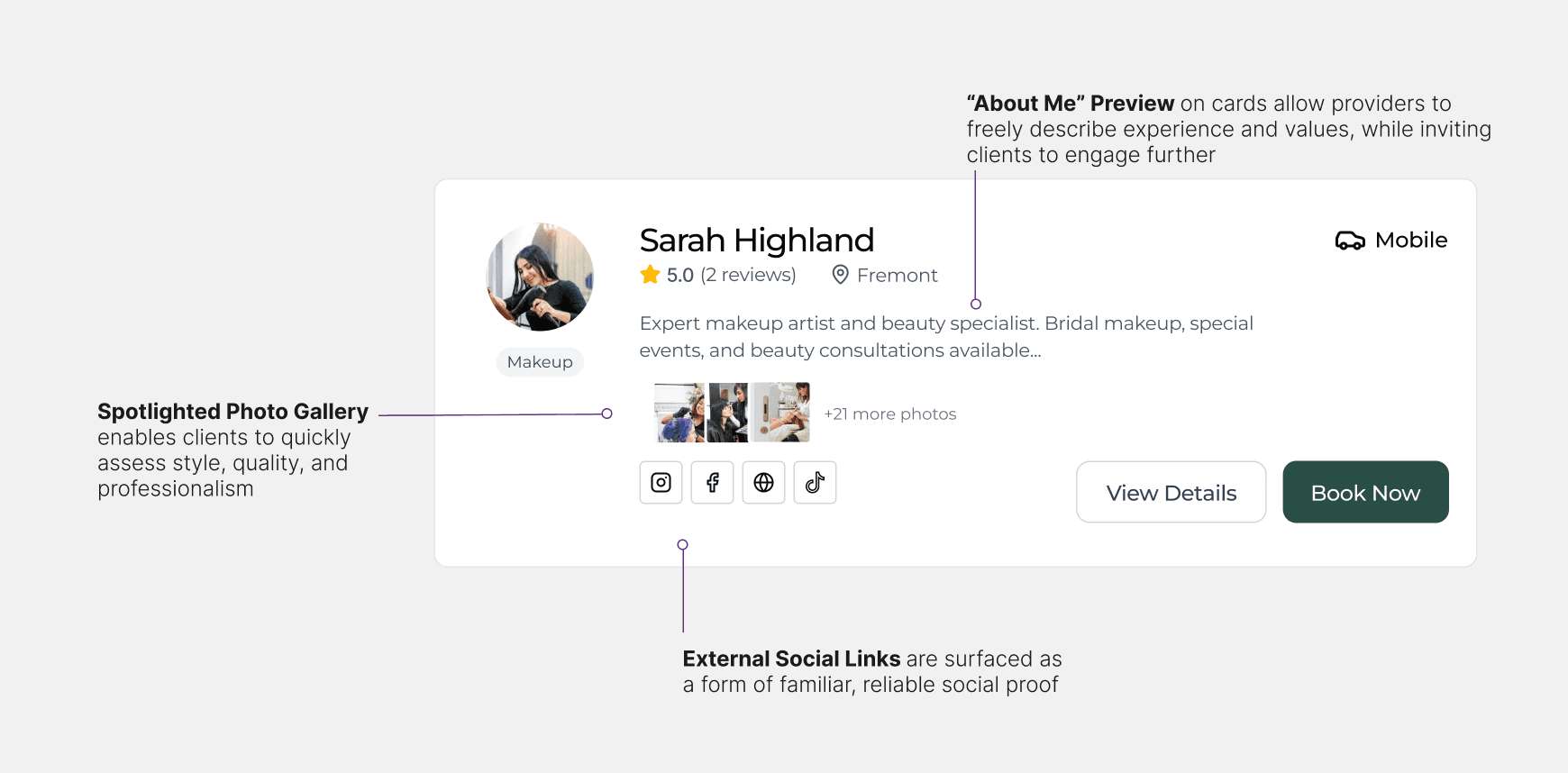
After learning that beauty industry clients value relationships with specific professionals, I decided to show recognizable, provider-owned trust signals: reviews, photo galleries, and social presence.
Tradeoff: Prioritizing honest provider representation and recognizable trust signals meant that we were represented by our providers, which could work negatively in some cases.
Providing Clarity to Clients on What To Expect From Platform Providers
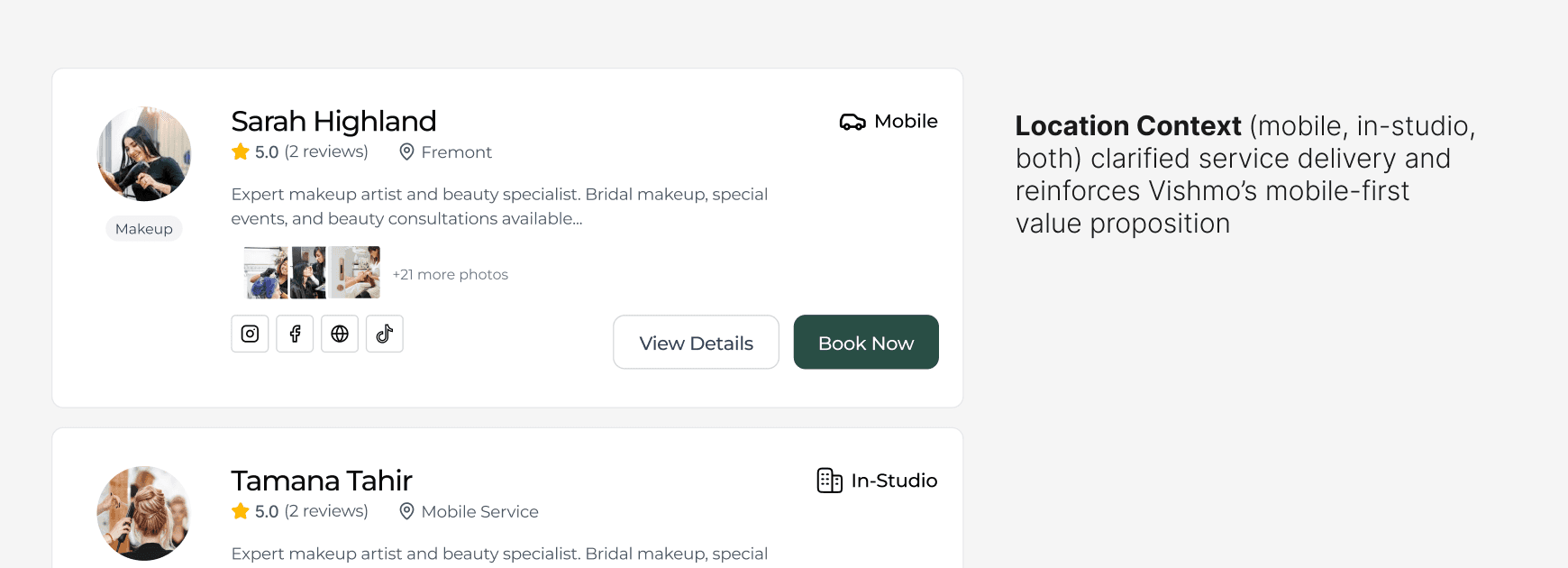
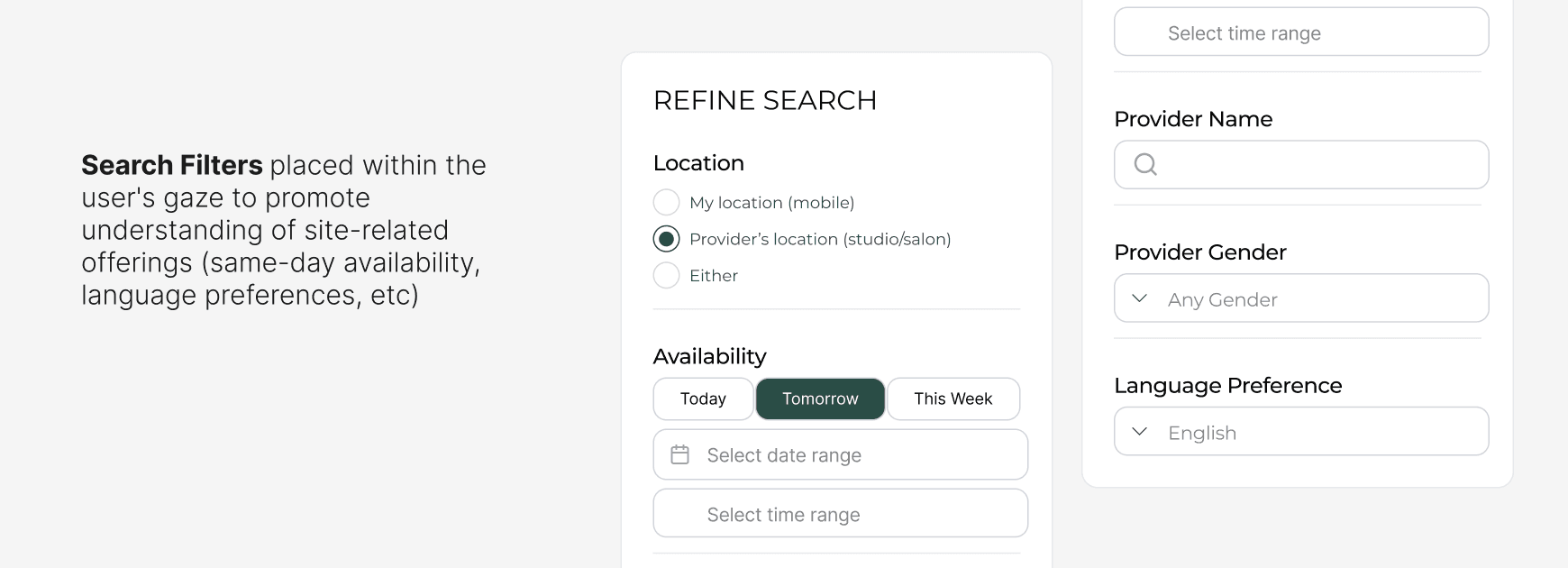
Details like location context, availability, and language flexibility implicitly communicated the variety of options & the level of customization a client could expect for meeting a provider that is right for them.
Tradeoff: Showing variability relied on there being enough providers from diverse skillsets, which we did not have in the beginning. This was a decision that took the risk of anticipating scale before we had it.
IMPACT
Redesigns Led to More Page Interactions & Interest in Joining
Without the resources for formal testing, we measured success through site engagement and provider feedback. Booking clicks increased 200% and average time on page grew 4.5x, which signaled that clients were exploring providers rather than bouncing.
More concretely, providers switching from competitor platforms cited the search experience when explaining why Vishmo felt more credible, which was validation for our product direction.
DELIBERATE UN-DESIGNS
Deciding to Protect Provider Perception to Earn Platform Credibility
The platform's credibility is only as strong as how good its providers look. So some common marketplace patterns were intentionally discarded to avoid disadvantaging new providers and undermining trust in them.
Un-Designing Service Prices on Provider Cards
Although revealing prices on cards increased the amount of clarity being granted to clients, showing prices too early risked price manipulation, which does not reflect well on some providers.
Therefore, service pricing was moved into provider profiles.
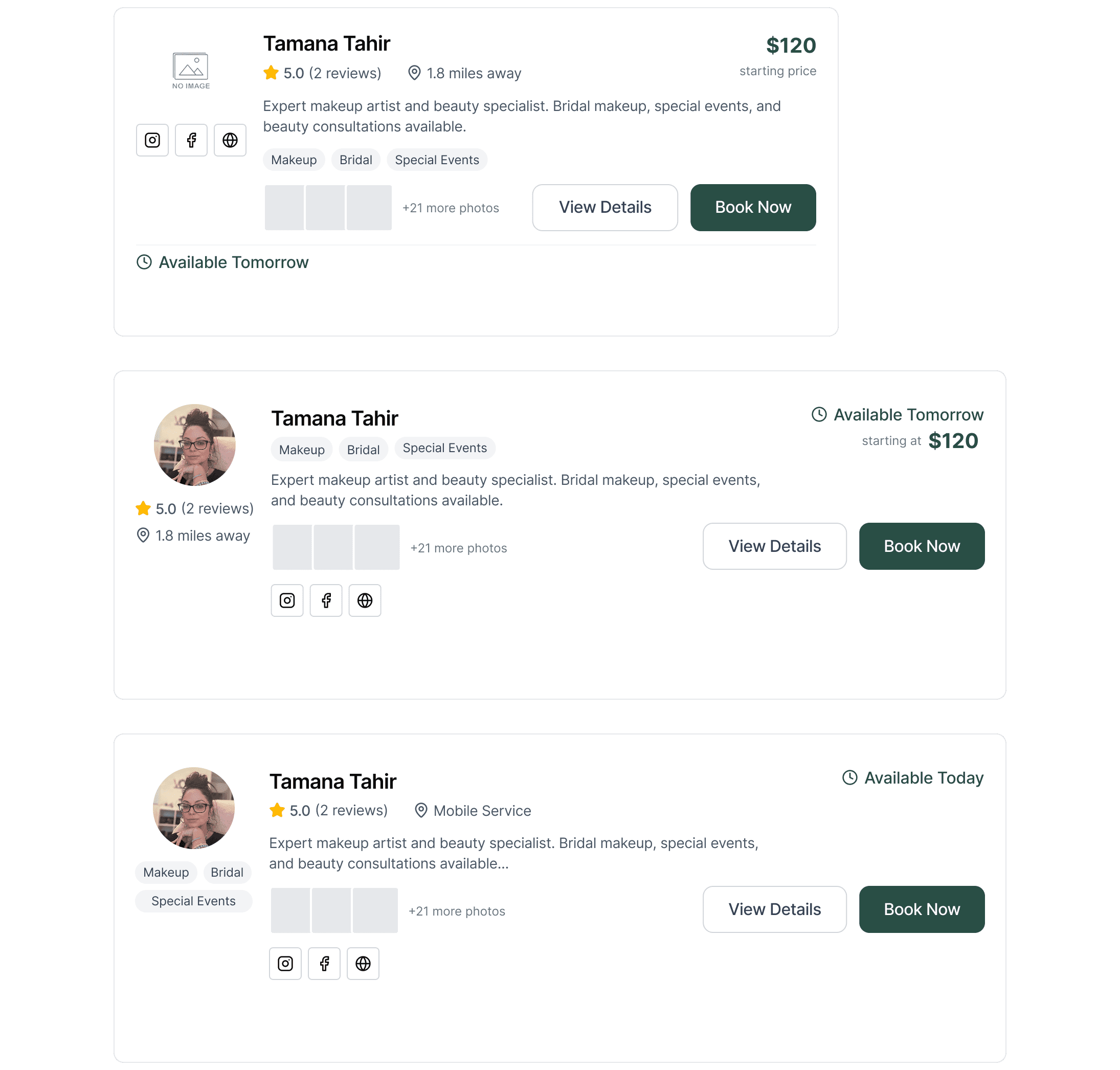
Un-Designing Experience Level on Provider Cards
Experience level was explored as both a filter and card attribute, but removed to avoid disadvantaging new professionals and recent beauty school graduates.
Instead, experience could be communicated organically through provider bios, preserving fairness while allowing differentiation.
Un-Designing Service Selection as Cards
Although listing service options as cards over personal provider cards would bring clients to their desired service faster, I designed around the relationship-driven nature of the beauty and wellness industry, where the person or salon providing the service matters (and needs to appear trusthworthy).
DESIGN EVOLUTION
Adjacent Design Decisions for a Consistent Experience
These design decisions evolved significantly from initial concepts based on provider feedback.
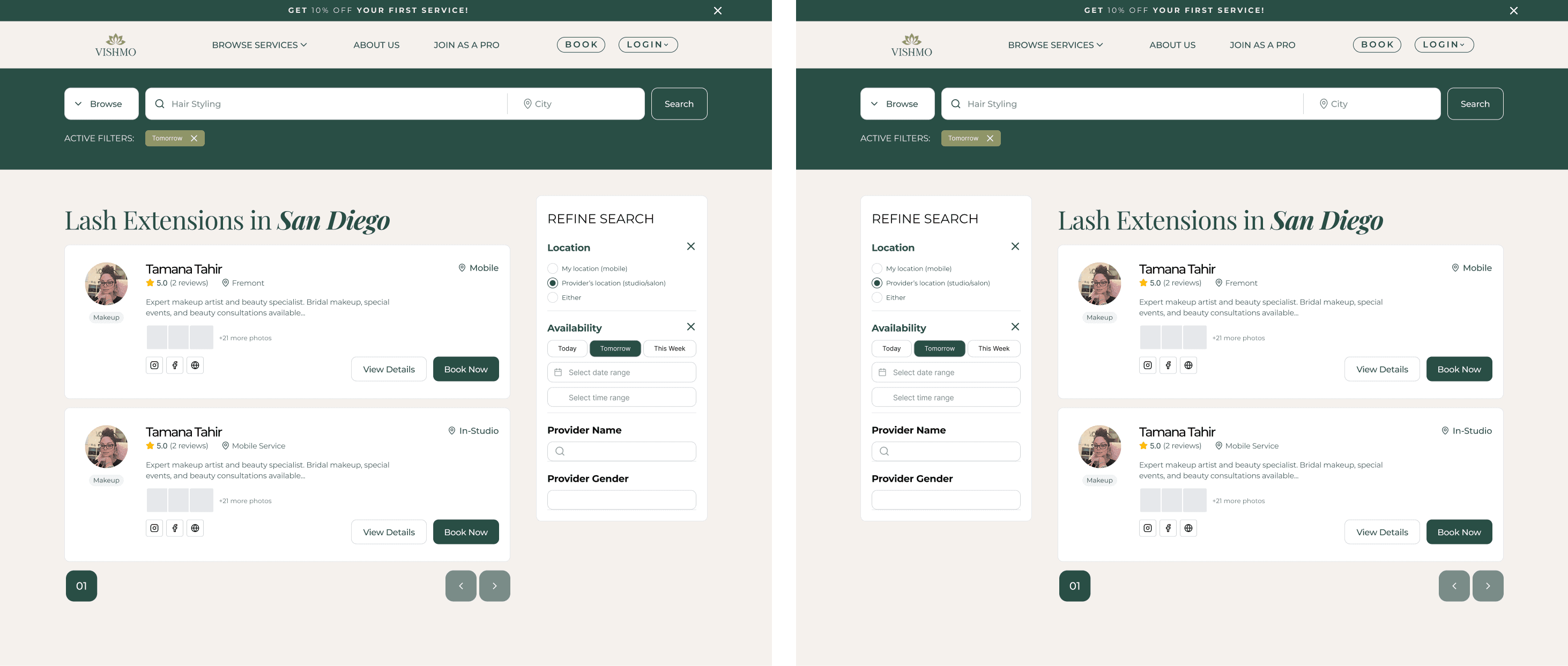
Encouraging the Use of Filters
Emphasizing filters as core to the search experience (placing them on the left) demonstrated our matchmaking capabilities, while de-emphasizing them (placing them on the right) brought clients to providers faster.
I chose to encourage the use of filters to communicate our value proposition of being a platform that supports mobile providers and same-day bookings.
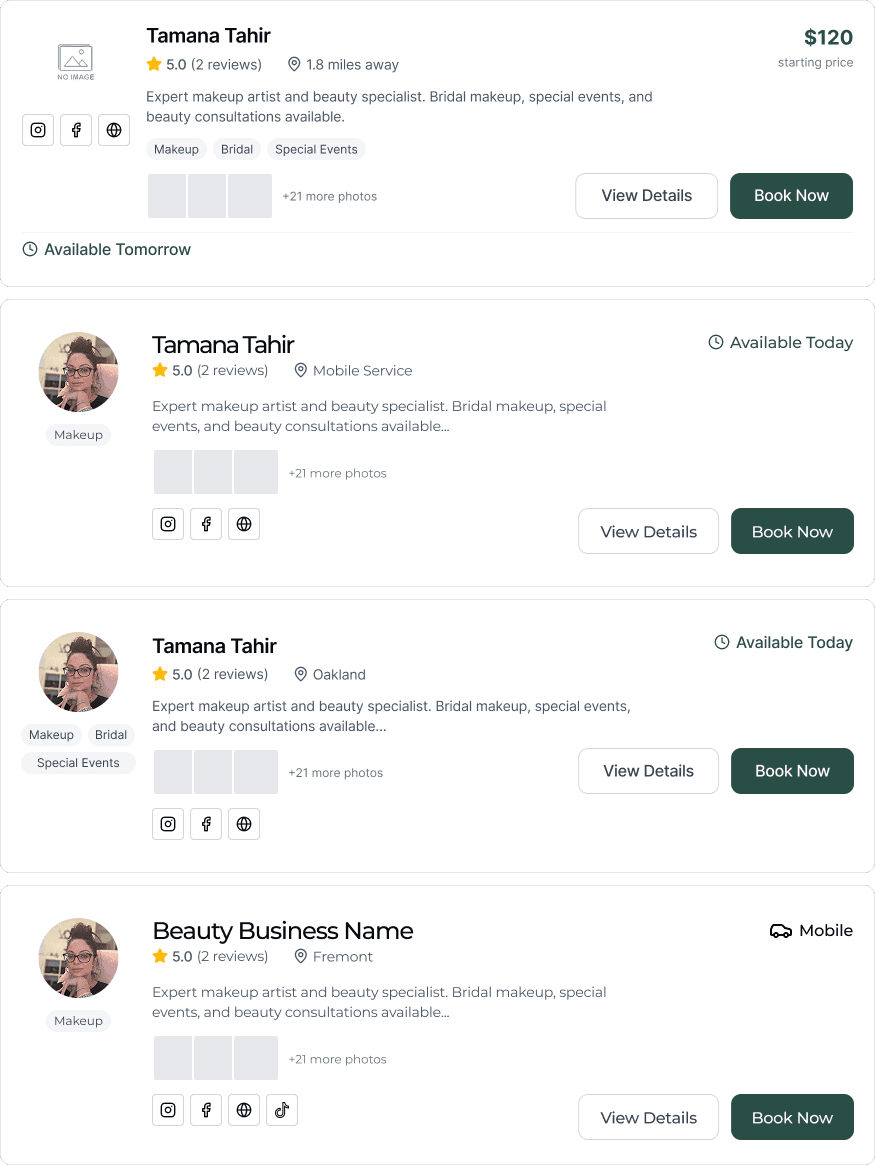
Communicating Mobile Capabilities & Location
Providers can be compared across several factors like price, availability, and location. I prioritized highlighting location/travel capabilities after our team aligned on setting mobile services as a core Vishmo-defining capabilitiy.
DEFERRED FOR V2 (STARTUP LIMITATIONS)
Balancing Feature Requests with Engineering Team's Capacity
Our team sprint produced additional ideas that were put on hold until we could get user to test and validate the current design. This included importing reviews from Google/Yelp, allowing for inquiry messages before booking, and transforming the search box so that it acted as a hybrid browse and search box. Deciding to wait for user feedback would allow us to refine and prioritize what aspect of search to improve upon.
REFLECTION
Learning to Prioritize Platform Trust over Booking Flow Efficiency
From this thought process I learned that early-stage marketplaces like Vishmo can't rely on conventional markers of platform authority since they haven't earned it yet. Next time, I'd test assumptions with providers earlier—we spent two weeks on an experience level filter that provider feedback immediately ruled out. Amidst our "disadvantages" as an early-stage platform, the constraint of having <20 providers ended up forcing better design decisions than scale could have. While I still intuitively prioritize designing for scale, I now understand the need to design for constraints rather than optimization to boost the launch of a platform.